

The Input Struggle
ou’re being asked to represent everyone… with input from almost no one.
Most cities aren’t short on feedback—they’re short on trustworthy signal.
When a decision heats up, the “data” you can access tends to come from the same small set of sources: a DIY link, a comment pile-on, a vendor report that shows up late, or whoever had time to attend a meeting. That’s not public input. It’s self-selected input—the equivalent of watching a few fish swim to the dock and assuming you’ve sampled the whole lake.
And that’s the real bind: leaders are expected to make decisions for the full community while knowing the loudest channels are often the least representative. The cost isn’t abstract—misreads, backlash, delayed decisions, and course corrections that burn staff time and political capital.
Collecting Comments vs. Measuring Percentages
Every city already has ways to collect comments—meetings, forms, social, platforms. The problem is: comments don’t tell you percentages. FlashVote is different: it’s a Scientific Survey program that’s fast and lightweight for residents, but still gives you statistically valid results you can use as decision support. So you’re not choosing between ‘engagement’ and ‘data’—you finally get both.”
- Resident-friendly: short, multi-channel participation (meets people where they are).
- Decision-grade: you get percentages (not just anecdotes) and “decision receipts.”
- Modern speed: results in days, not months.
What about public meetings for gauging community sentiment?
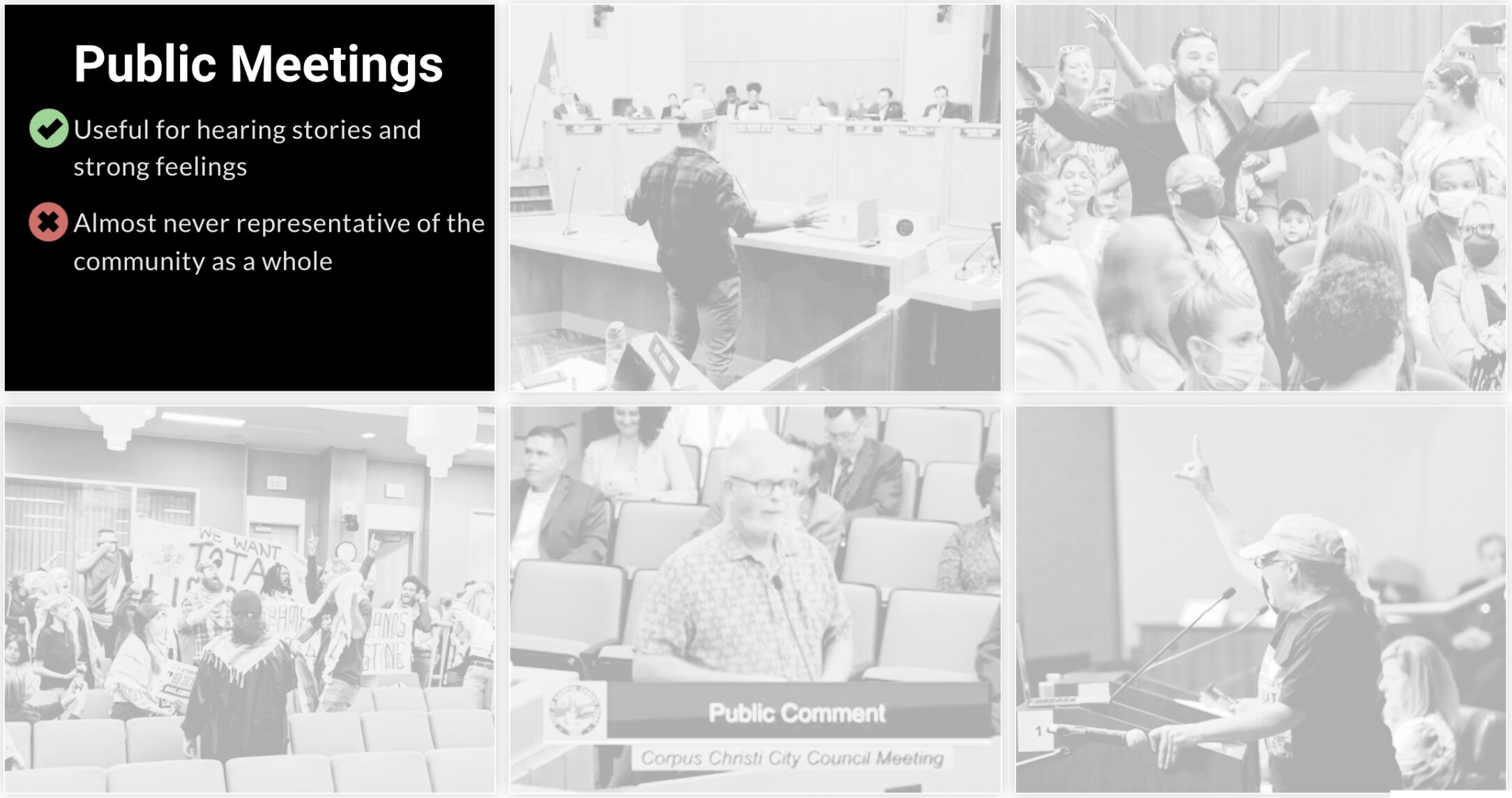
Public meetings are important for transparency and dialogue – but they’re a terrible way to measure public opinion. The people who show up are almost never representative of the community as a whole. Research consistently finds they’re older, whiter, and more extreme in their views. So while meetings are useful for hearing stories or strong feelings, they’re not reliable for gauging what most residents think. Worse, decisions based on meeting input alone often get derailed later by silent majorities who were never heard in the room. If you want community direction – not just community drama — you need representative data to go with your anecdotes.
Why not use SurveyMonkey to gather resident input?
SurveyMonkey and similar tools are great for casual feedback, but they’re not built for decision-quality input. You don’t control who responds, which means the results reflect self-selection bias – often dominated by those with strong opinions or personal stakes. So even if the survey looks clean and the charts are colorful, the data underneath is flawed. That’s why cities using tools like these often end up with misleading results, policy backlash, or costly course corrections. If you’re making decisions for the whole community, you need input from the whole community — not just the folks who clicked a link.
Why not just ask residents on Facebook?

Social media might feel like a fast way to “take the pulse” of the community, but in reality it amplifies a narrow slice of voices – the most online, most vocal, and most opinionated. It’s a classic case of mistaking noise for signal. Studies have shown that online commenters and social media users are demographically and behaviorally unrepresentative of the general population. Governing by social media input is like navigating by Yelp reviews – you’re flying blind and skewed by extremes. If you want real public input, you need a method designed to minimize self-selection bias and actually reflect your residents.
We do a biannual satisfaction survey? Those are scientific, right?

Yes, traditional satisfaction surveys can be scientific – but they’re slow, expensive, and usually built for benchmarking, not decision-making. By the time the results arrive, the moment to act has often passed. Plus, these surveys are broad by design, so they rarely provide the specific, actionable input that leaders need on individual topics. They’re a great “rearview mirror” but a poor steering wheel. FlashVote complements these efforts by giving statistically valid, rapid-turnaround input on timely decisions – when it matters most. It’s not a replacement; it’s a missing piece.
“I can’t imagine not having FlashVote available to me!”
Laurie Hokkanen – Administrative Services Director
City of Plymouth, MN